
First-time buyers
First-Time Homebuyer Hacks
What a lender actually reads, the quiet mistakes that sink first-time files, and five moves to make before you apply.
Get the guide
Financing a car while saving for a house? Same salary, same savings, and that one payment can change what a lender is able to lend you by a surprising amount. This chart shows the math by salary and by payment.
Who it is for: Anyone carrying a car payment while saving for a home, or choosing between a new car and a first house.
Prefer to talk? Call 732-686-9999
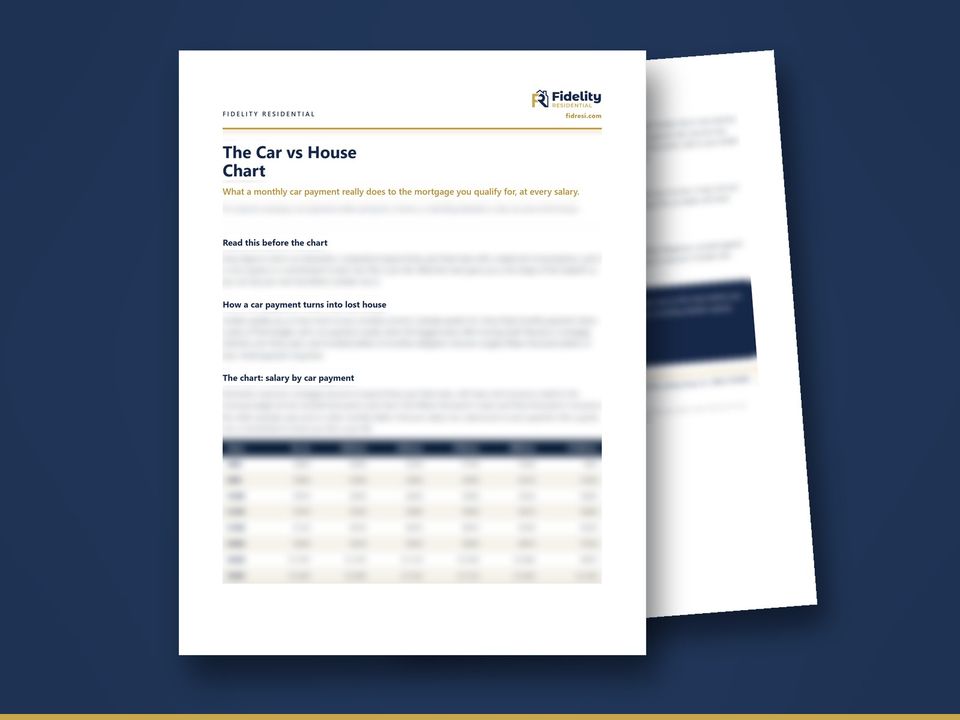
Lenders look at how much of your monthly income is already spoken for. After housing itself, a car payment is often the biggest piece, so it can shrink the loan amount that fits the same budget.
There is a twist: paying the car off right before you apply can hurt too, if it drains the savings your file needs. And sometimes the car is the right call.
The honest part. Every figure in the chart is an illustration, not a quote. Your file is your file.
Fill in the short form and choose email or text. We confirm your mobile number with a text code, then send you The Car vs House Chart.
Tell us who you are and where to send it. We confirm your mobile number with a text code first.
This form needs JavaScript. You can also call us at 732-686-9999 and we will send the guide.
Thank you, .
Your guide is ready.
Open the guide (PDF) (opens in a new tab)
We are also sending it to you by email and by text message. It comes from Fidelity Residential. To make sure our emails reach you, add [email protected] to your contacts or safe senders. If you do not see it, check your spam or junk folder.
Questions? Call us at 732-686-9999.
Please call us at 732-686-9999 and we will send you The Car vs House Chart.
We use these details to send what you asked for and to follow up about it. See our Privacy Policy.
Here is a plain summary of the main points in The Car vs House Chart. The full guide adds the chart itself, which lays out illustrative examples by salary and by car payment. Every figure in it is an illustration built on stated assumptions, not a quote and not a commitment to lend. What it gives you is the shape of the tradeoff, so you can see it before a lender runs your file.
When a lender sizes a home loan, it compares your monthly debt payments, including the new housing payment, with your gross monthly income. Every fixed monthly payment you already carry claims part of that budget: student loans, credit cards, and very often a car. After housing itself, a car payment is frequently the biggest piece. Whatever the car takes, the housing payment cannot use.
A mortgage is repaid over many years, so each dollar of monthly payment supports many dollars of loan. That is why a car payment that feels modest month to month can shrink the home loan that fits the same budget by far more than the car itself costs. The lever is small at one end and long at the other. The chart in the guide shows this row by row: find your salary, read across to your payment, and compare it with the column for no car payment at all. The gap between the two is what the car is costing your home budget.
It sounds like the obvious fix, and sometimes it is. But the guide asks two questions first.
This is not an anti-car guide. If the car gets you to work, or the payment is small against your income, it may cost you nothing you care about. The point is to sign both contracts with your eyes open. The car dealer will not show you what the payment does to your home budget, so the guide does.
A good conversation about your debts sounds like this:
A lender who answers those plainly, with your own file in front of them, is a lender you can work with.
An illustration, in words. Two friends earn the same salary and have saved the same amount for a first home. One has just signed for a new car; the other is still driving an older car that is paid off. When each talks to a lender, the car payment sits in the first friend’s monthly debts, so less of the budget is left for a housing payment and the loan that fits is noticeably smaller. Nothing else about them differs. The first friend decides to keep saving and pay the car down over time rather than drain the savings at once, and to talk to a loan officer again before moving any money. Same income, same savings, a different starting line.
To see what a housing payment looks like at a price you have in mind, try the mortgage payment calculator, or read our home purchase loans page for the programs that fit first-time and move-up buyers, the documents to gather and the steps to closing.
A lender compares your monthly debt payments, including the new housing payment, with your gross monthly income. A car payment takes part of that budget, so less is left for the housing payment, and the loan amount that fits the same budget is smaller.
It depends. Paying it off removes the monthly payment, but if it drains the savings you need for the down payment, the closing costs and your reserves, it can hurt your file more than the payment did. The closer you are to applying, the more it matters to talk to your lender before you move any money.
No. Every figure in the chart is an illustration built on stated assumptions, not a quote and not a commitment to lend. It shows the shape of the tradeoff; what a lender can offer you depends on your own file.
No. If the car gets you to work, or the payment is small against your income, it may be the right call. The point is to see what the payment does to your home budget before you sign for it.
Ask which of your monthly payments counted against your budget, how much room is left, how paying one debt off would change the loan amount that fits, and whether the lender would rather see that cash kept in savings.
What a lender actually reads, the quiet mistakes that sink first-time files, and five moves to make before you apply.
Get the guide
How lenders size a payment, why buying power moves, and the honest case for waiting.
Get the guide
The ways to pay for mortgage insurance, which one ever ends, and how to ask for it to be removed.
Get the guideApply online, get a quote, or talk it through with a licensed loan officer.
This page is general information, not a commitment to lend. Programs, terms and eligibility depend on credit, income, property and underwriting review and are subject to change without notice.
Last reviewed: